

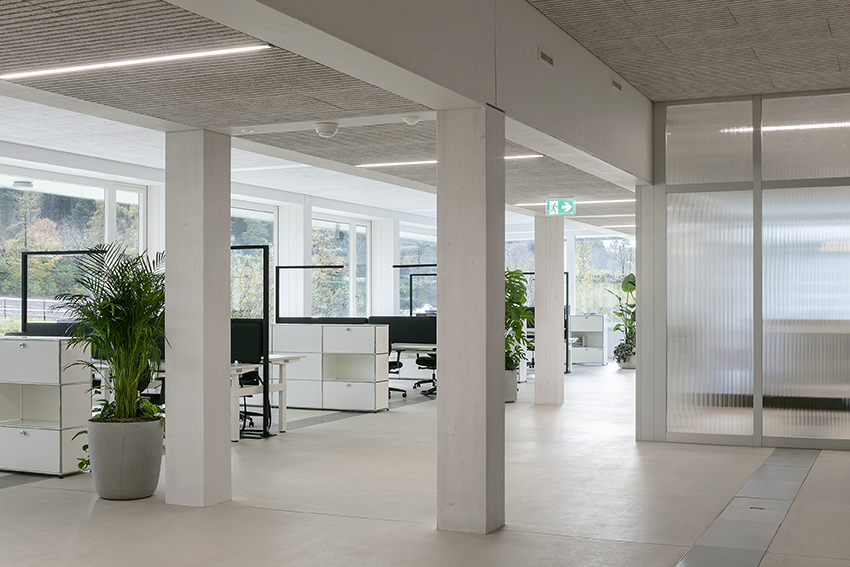
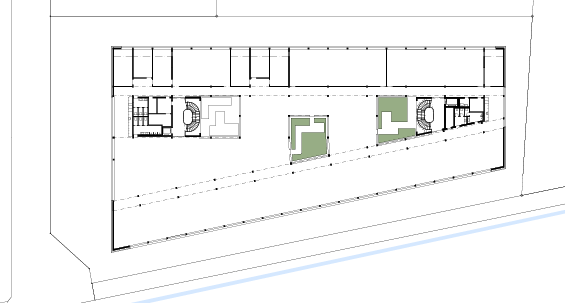
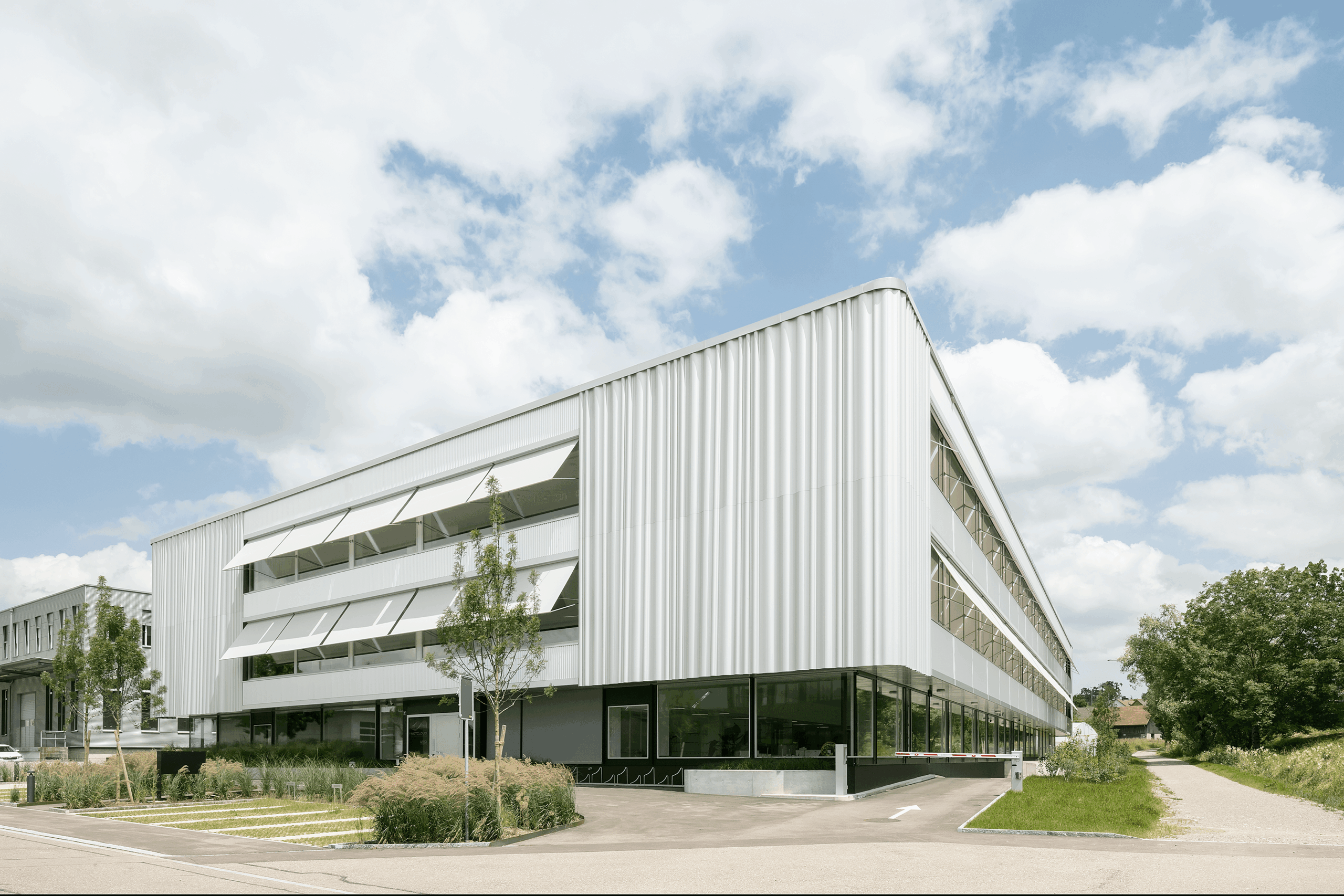
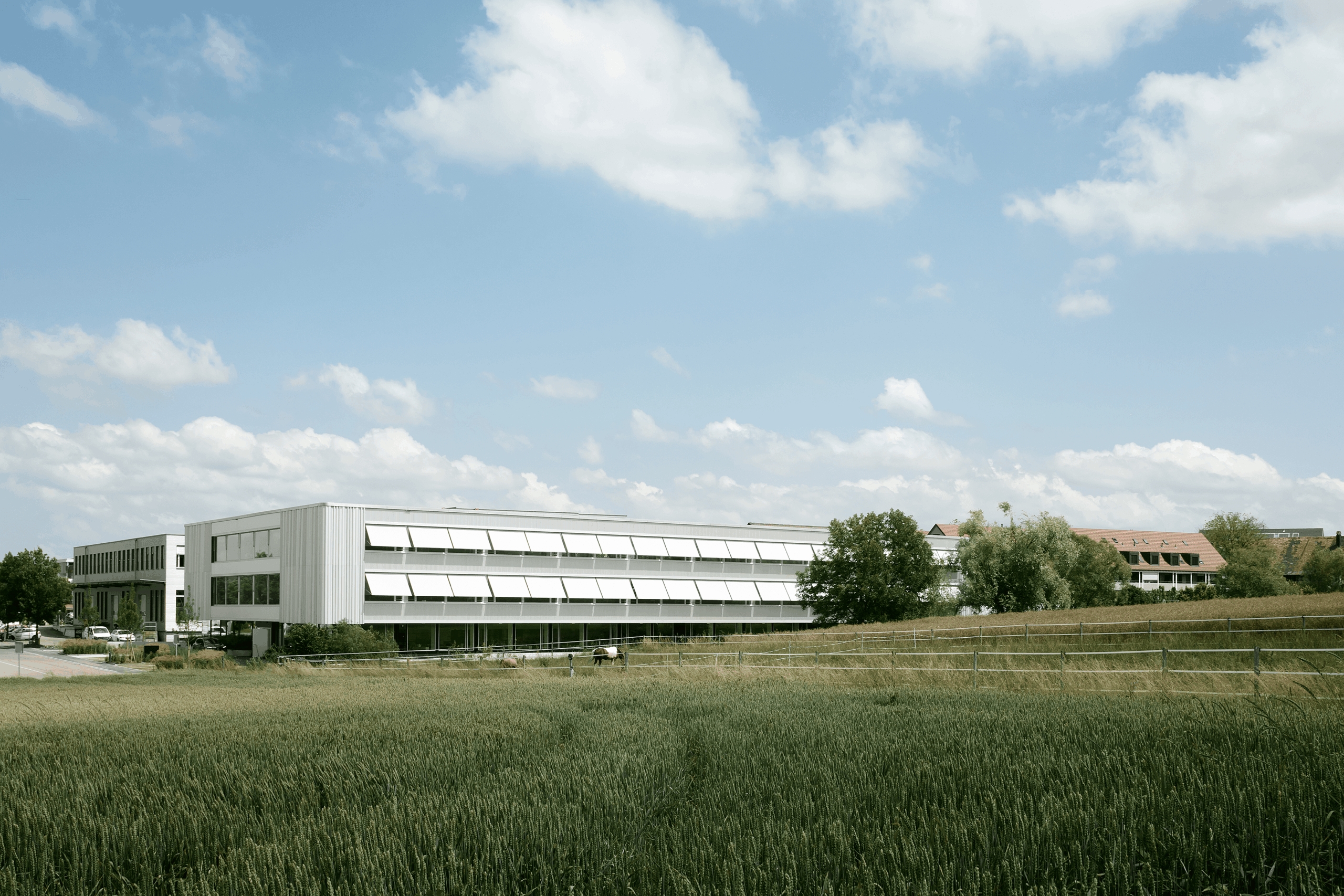
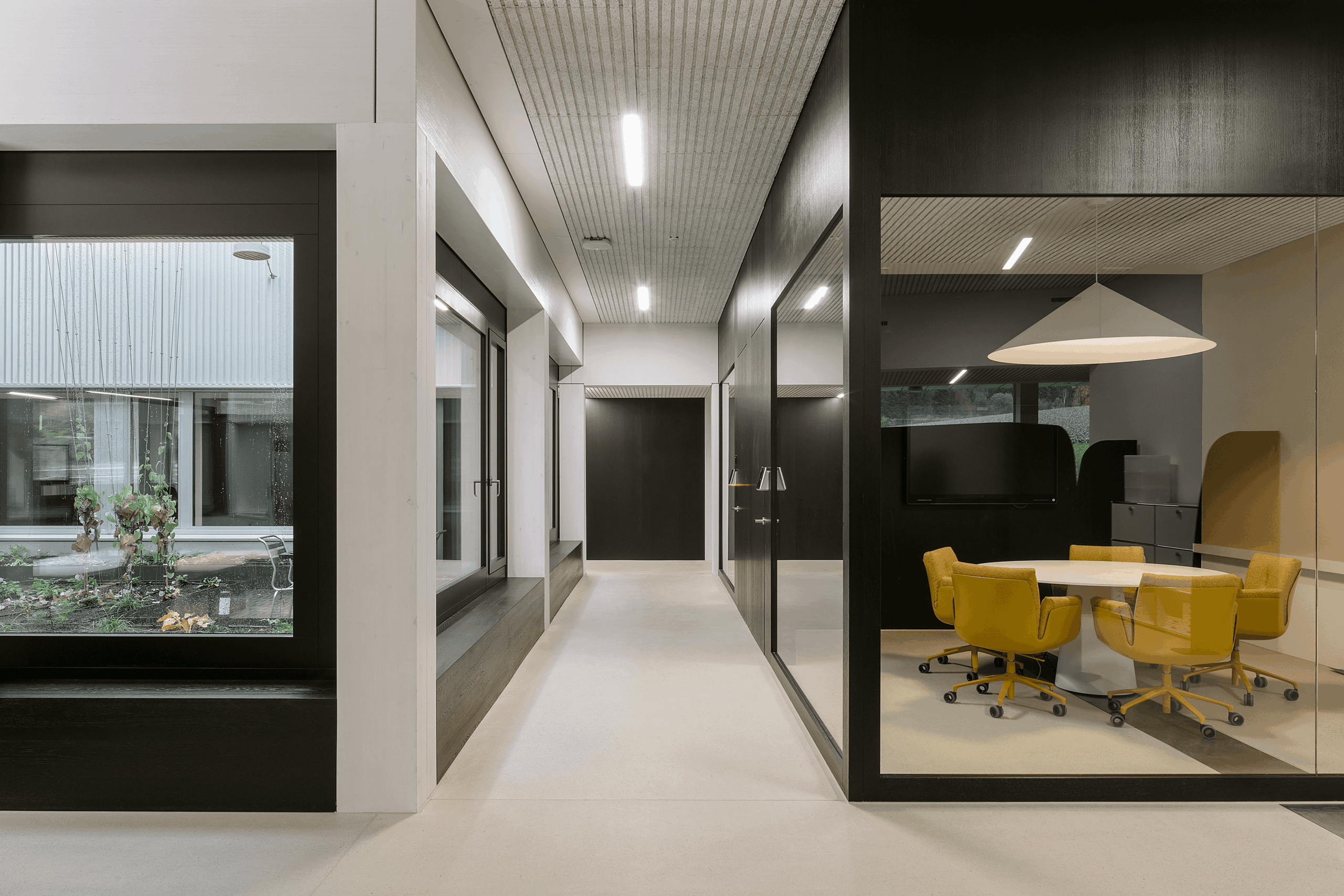
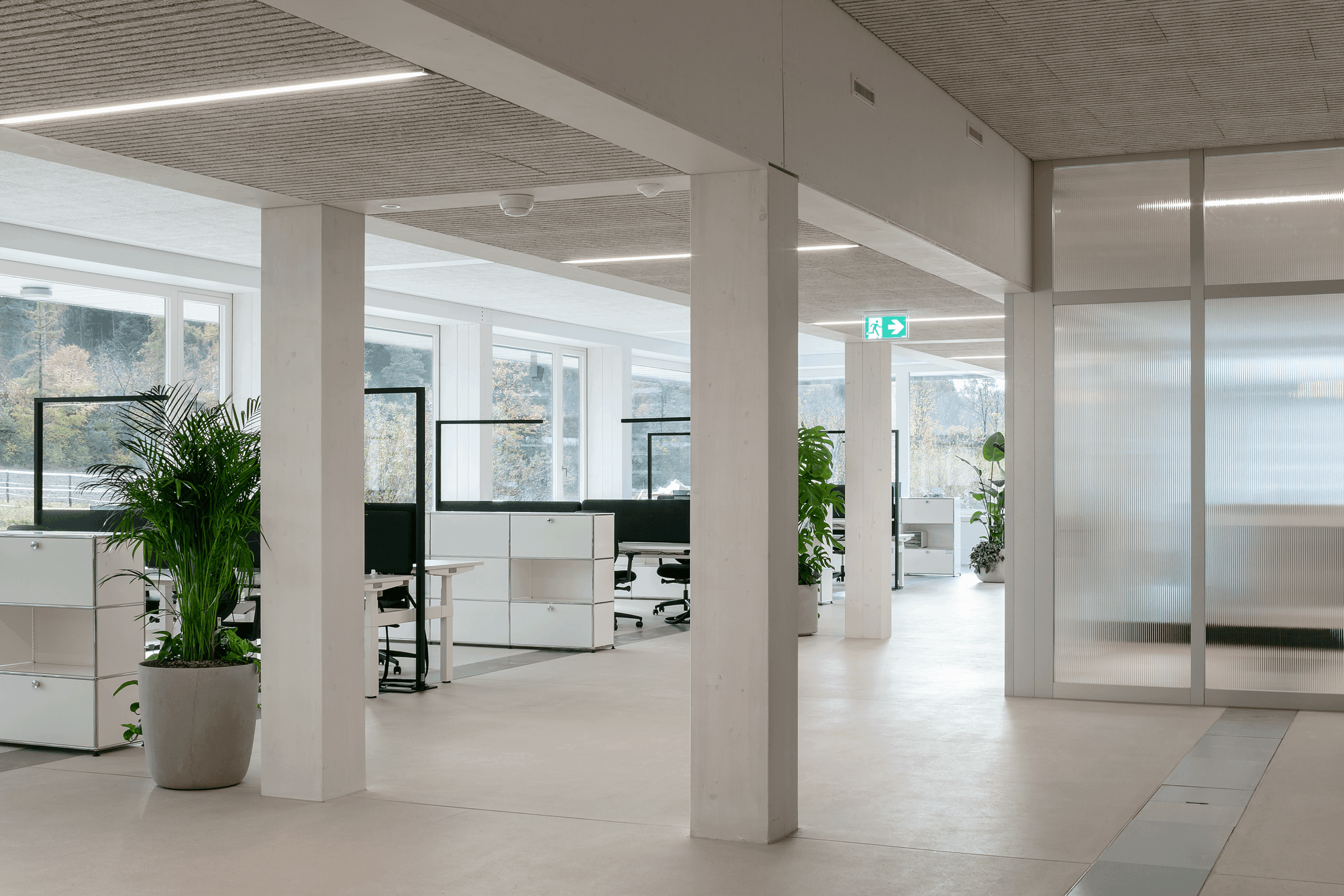
Good natural lighting conditions was one of the main demands of the proprietor. The building therefore features three airy atriums. Given a floorplan in the shape of an irregular trapezoid, the main façade facing west measures about 40 metres and is thus nearly double as long as the east side with 22 metres. Most of the offices and meeting rooms are located along the 80-metre-long north- and south-facing sides of the block.
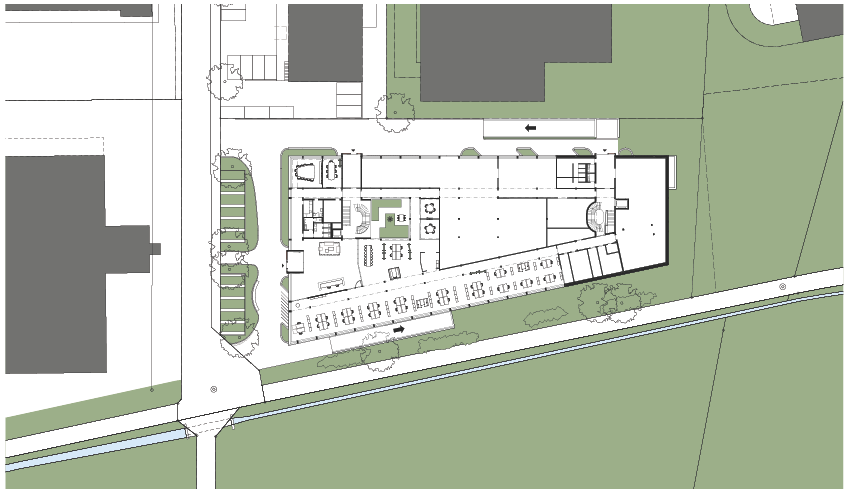
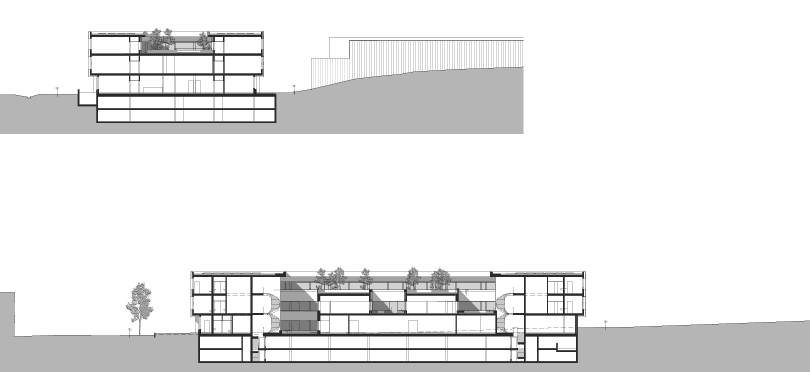
From the outside, the building appears as a three-storey structure, while the inside surprises visitors with courtyards of various heights and sizes.
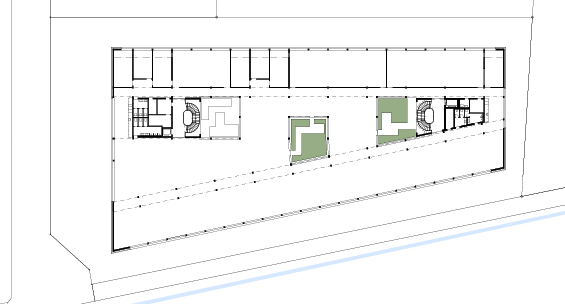
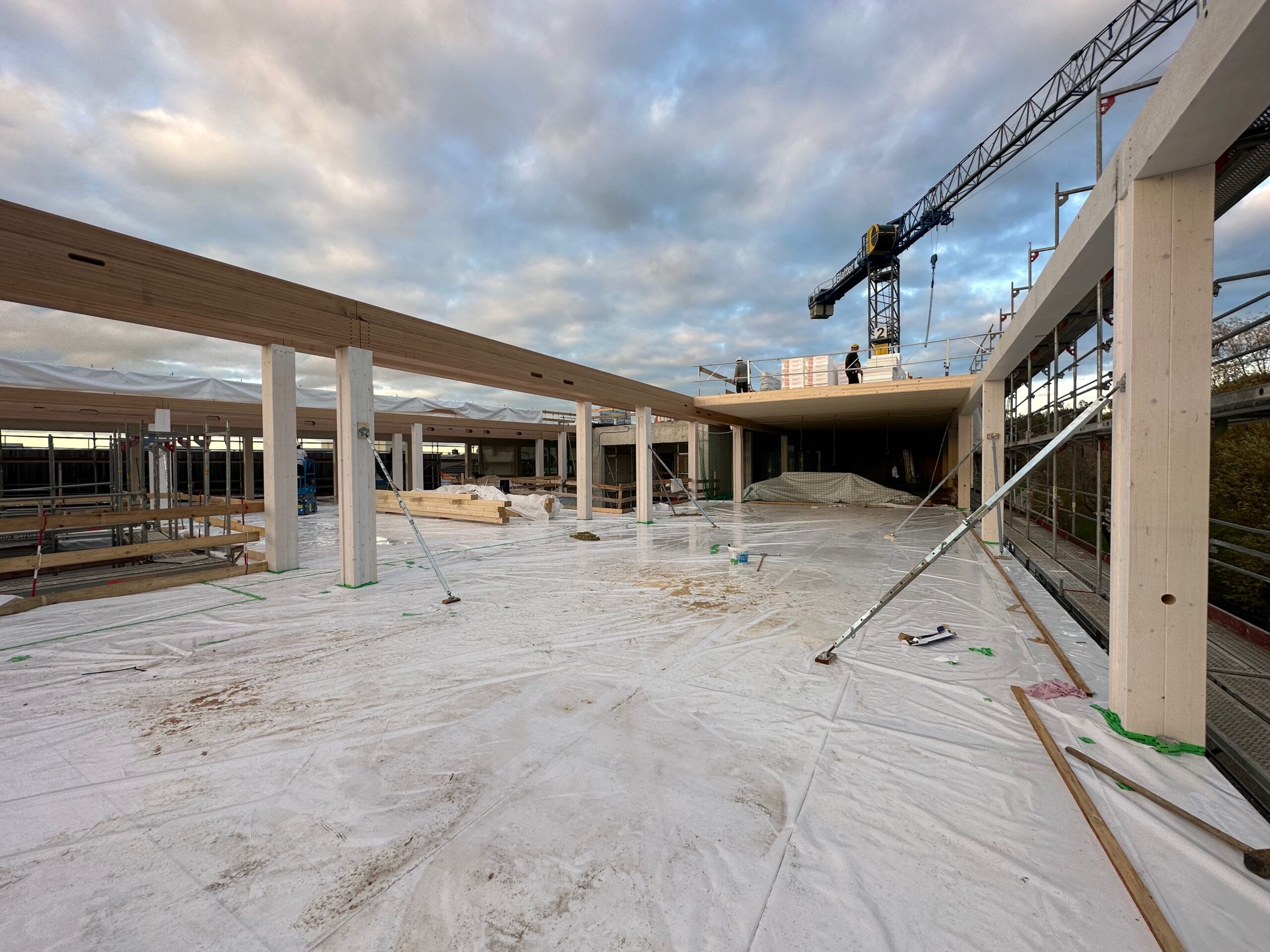
On the second floor, the building surrounds a large atrium space. Here, we find offices and meeting rooms as well as a large dining area that also serves as a lecture hall. The upper floor projects 1.5 metres out from the ground floor on all sides. Two of the atriums are connected to two curved staircases whose shape and design are reminiscent of stylish 1950s architecture. The space allocation plan provided for 155 workstations at the time of first occupation at the end of 2023. By 2028, this number is to increase to 260.
Skeleton construction combining glulam and BauBuche
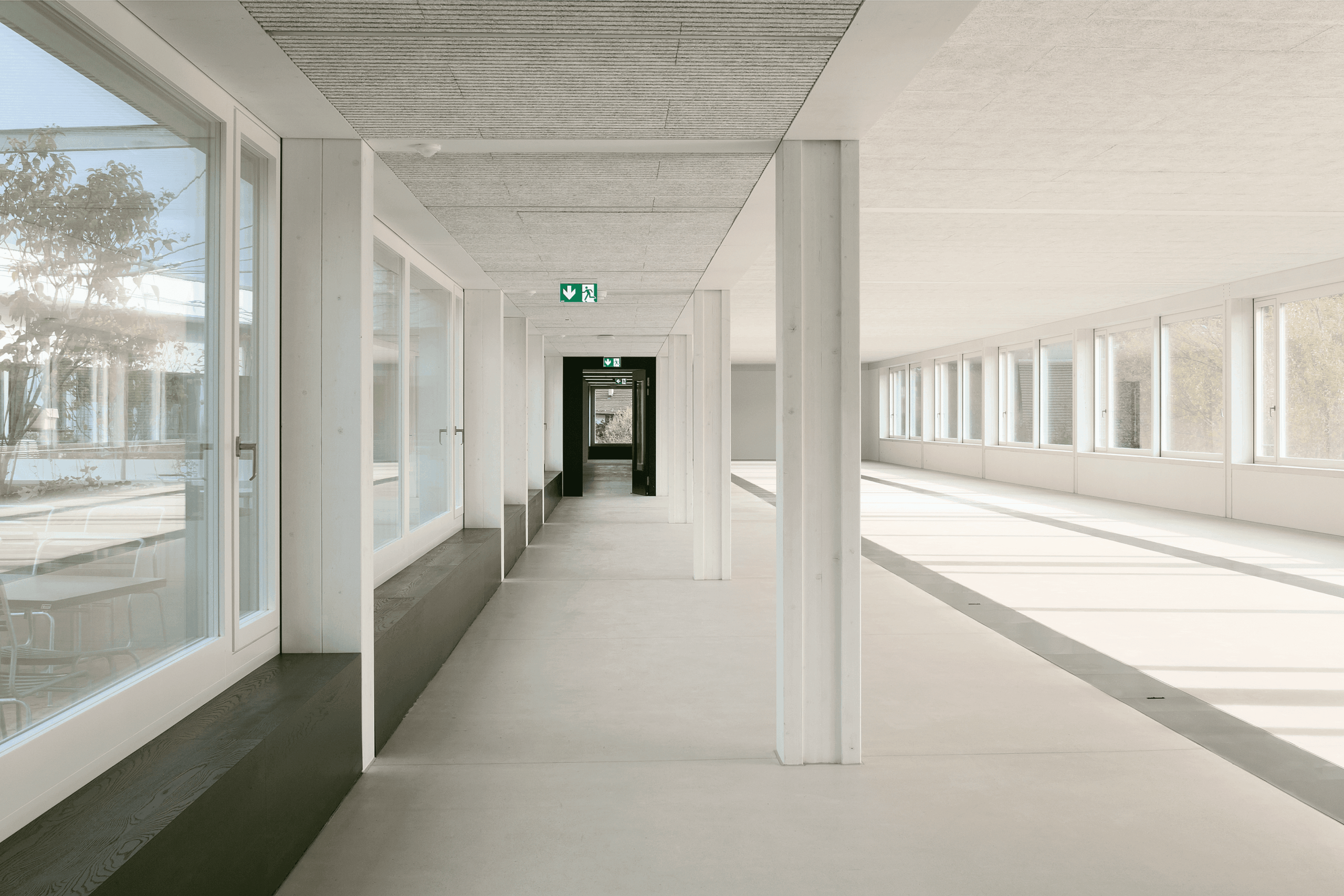
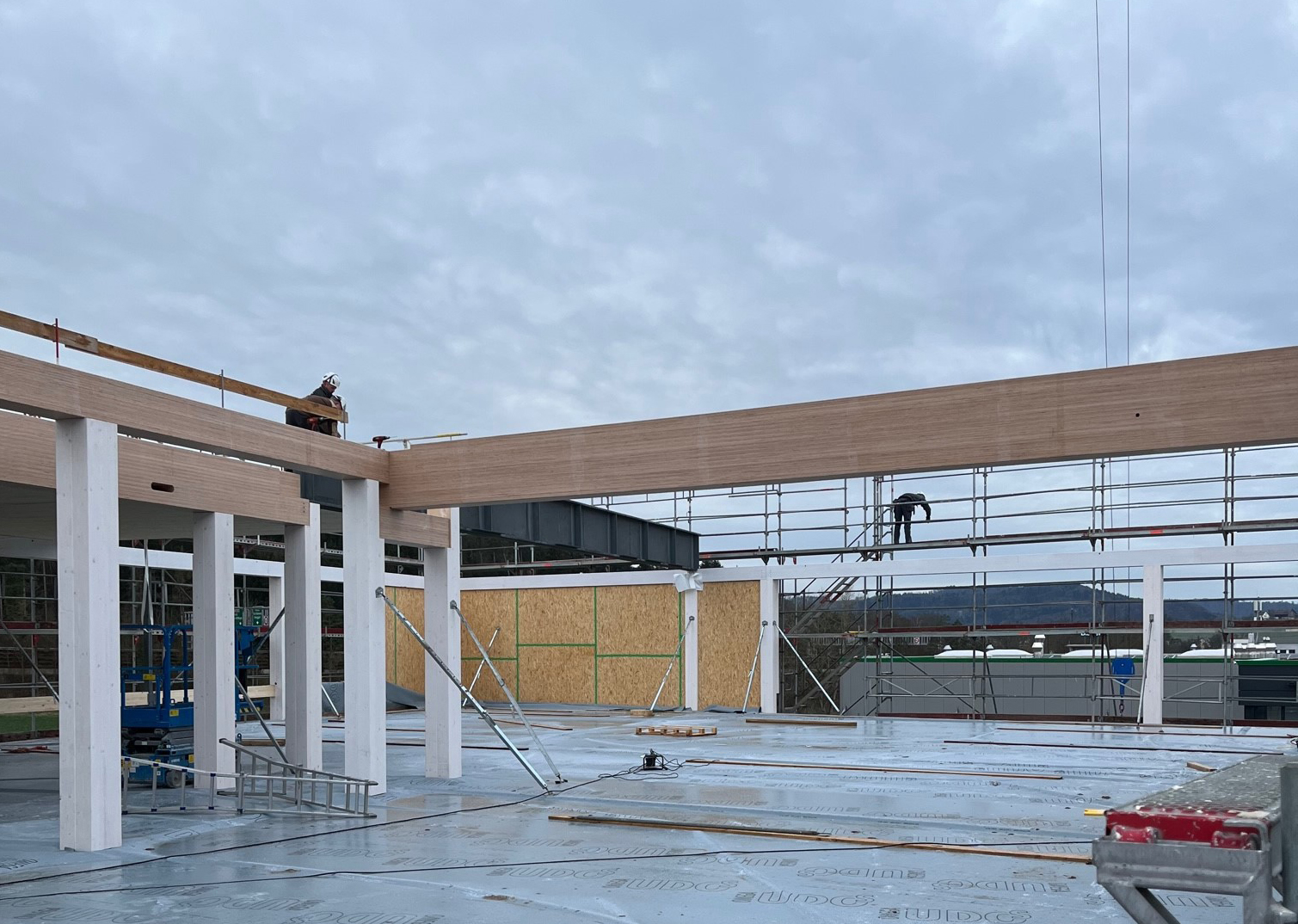
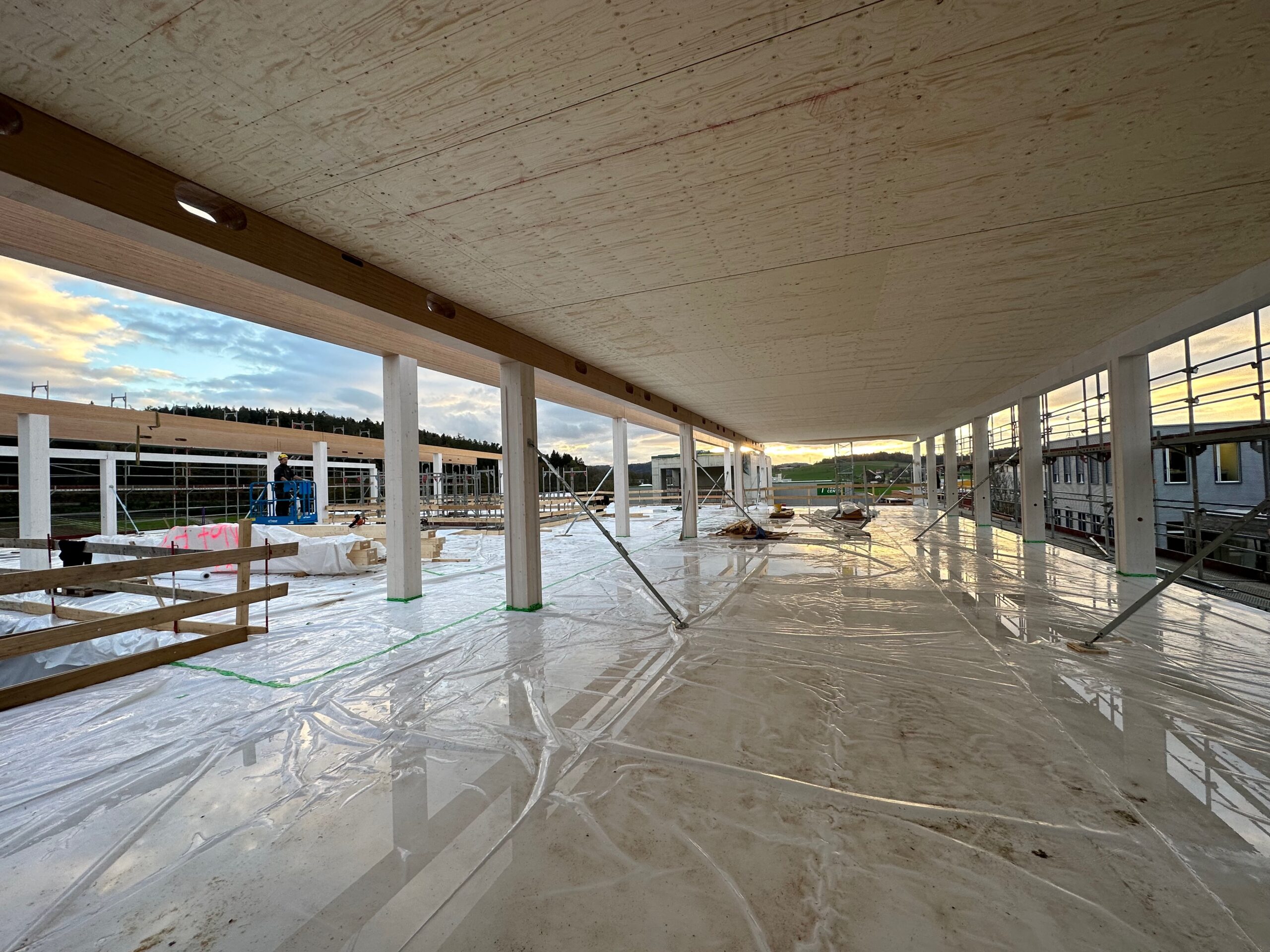
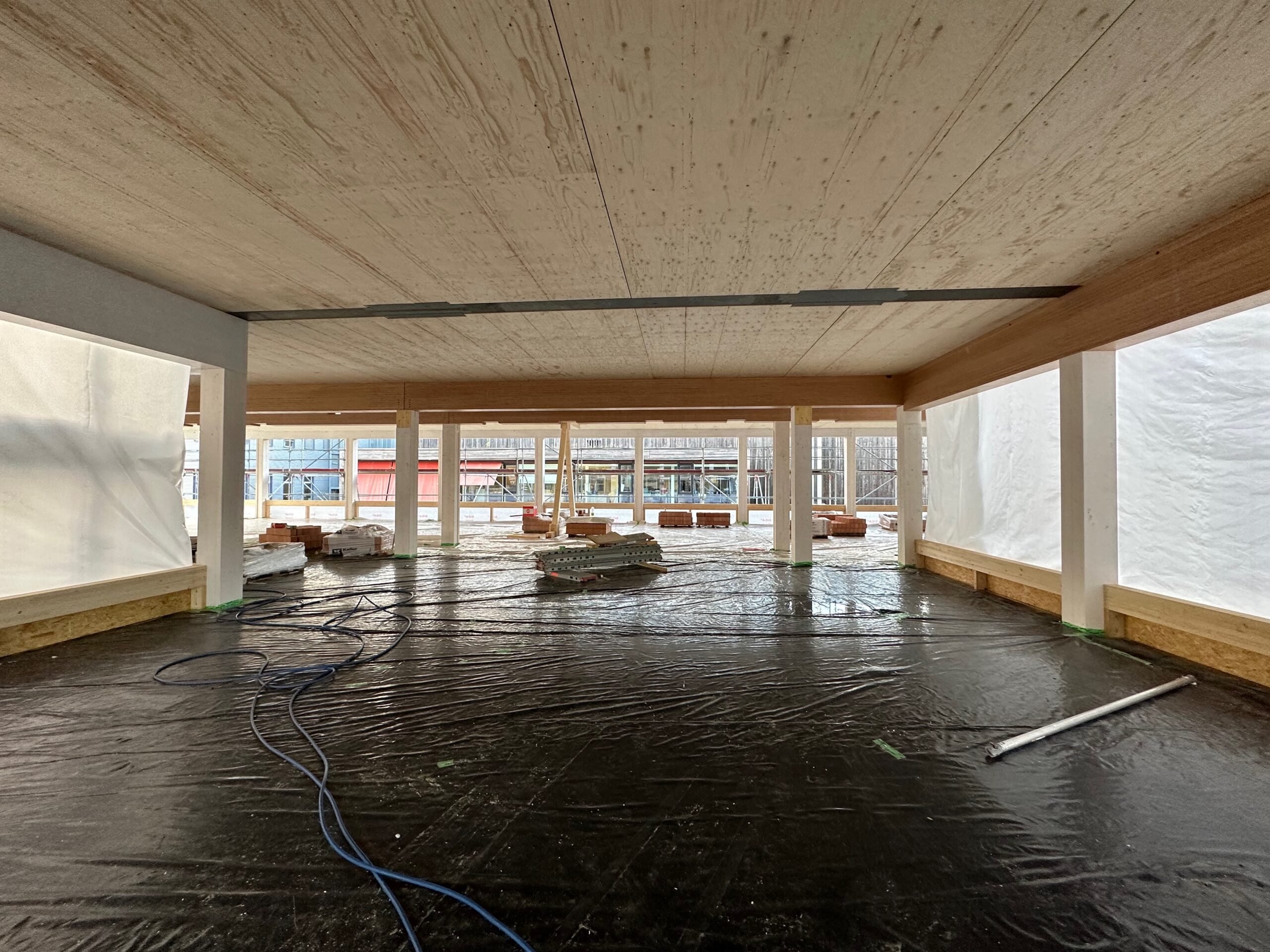
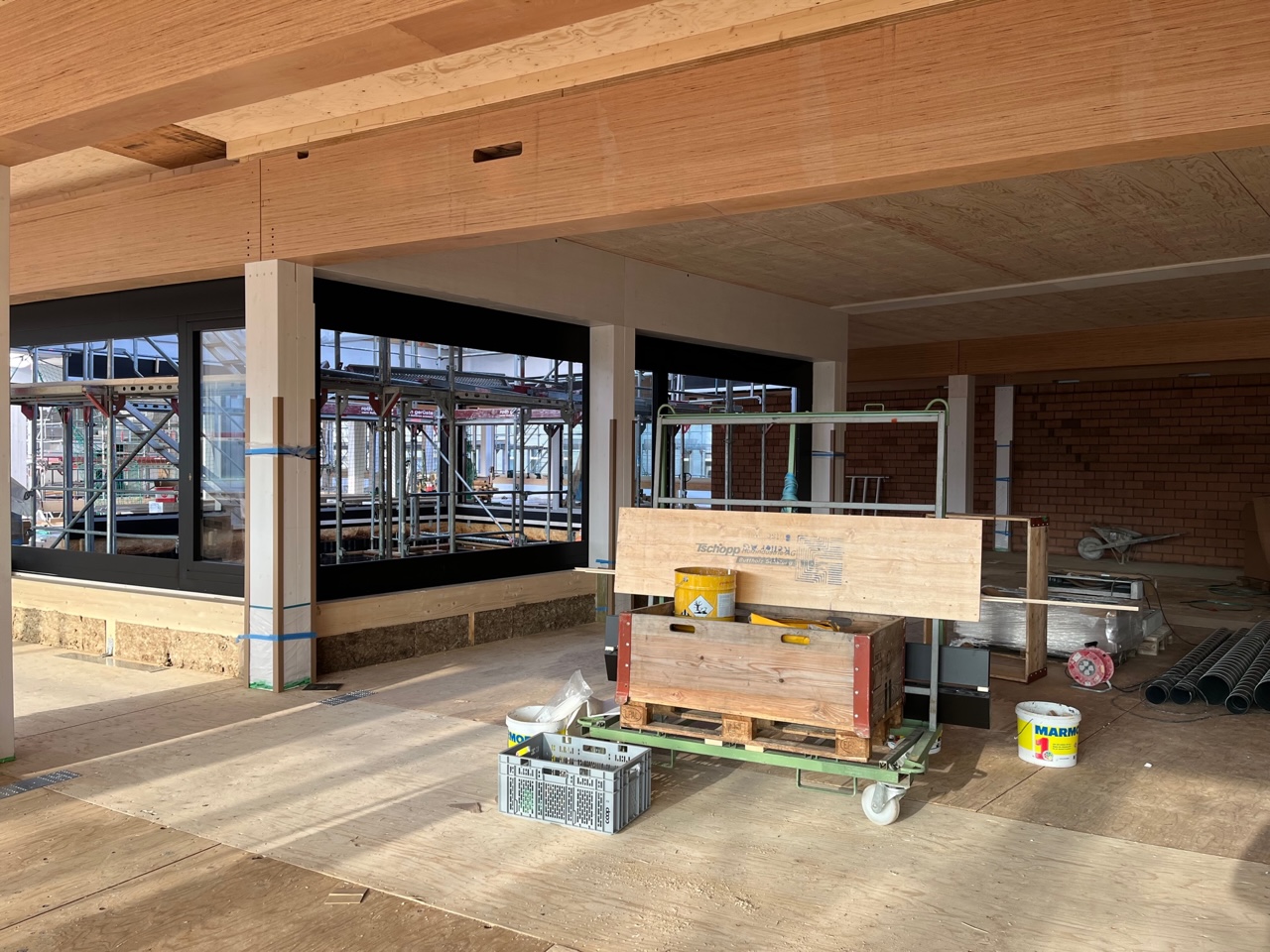
The primary and secondary structures of the office building are made in a combination of glulam and BauBuche. Vertical loads are transferred through square glulam posts with a 32 cm cross-section. At ground floor level, these posts are positioned at 4-metre intervals along the façades and at 8-metre intervals along the access corridors. They carry BauBuche girders measuring up to 8 metres in length featuring various cross-sectional dimensions, depending on their position within the building. The false ceilings and the roof consist of hollow box elements. In the corridors, these are standard elements. In the offices and meeting rooms, they are designed as acoustic elements.
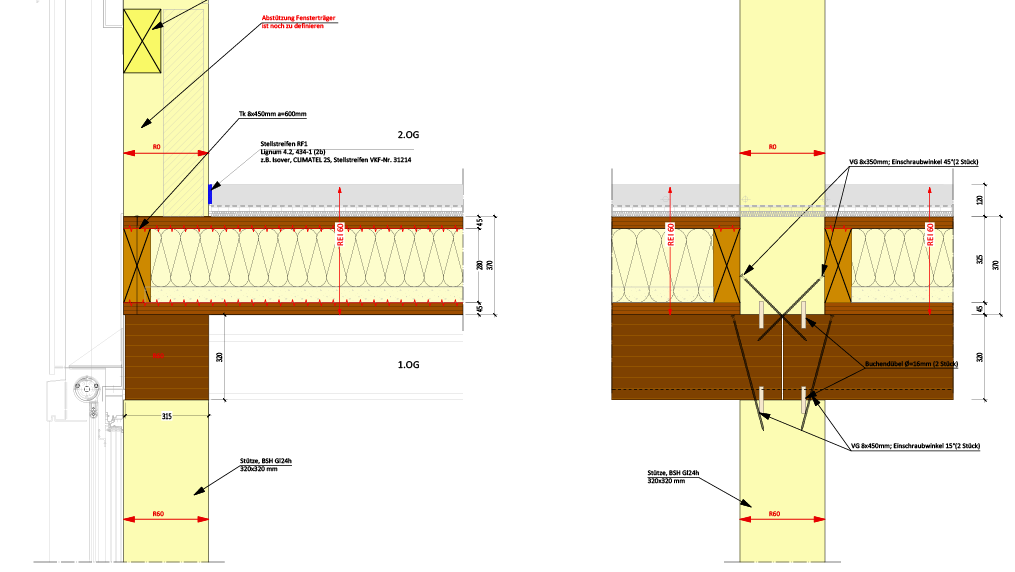
The corridors link the rooms along the longitudinal façade sections. Here, the posts are arranged in double rows with a centre-to-centre distance of 2 metres, resulting in a clear width of 1.68 metres. In the corridors, most of the building services equipment could be installed in the about 1 metre high space above the suspended ceiling. The supply air vents are integrated into 8 cm high slots in the BauBuche girders.
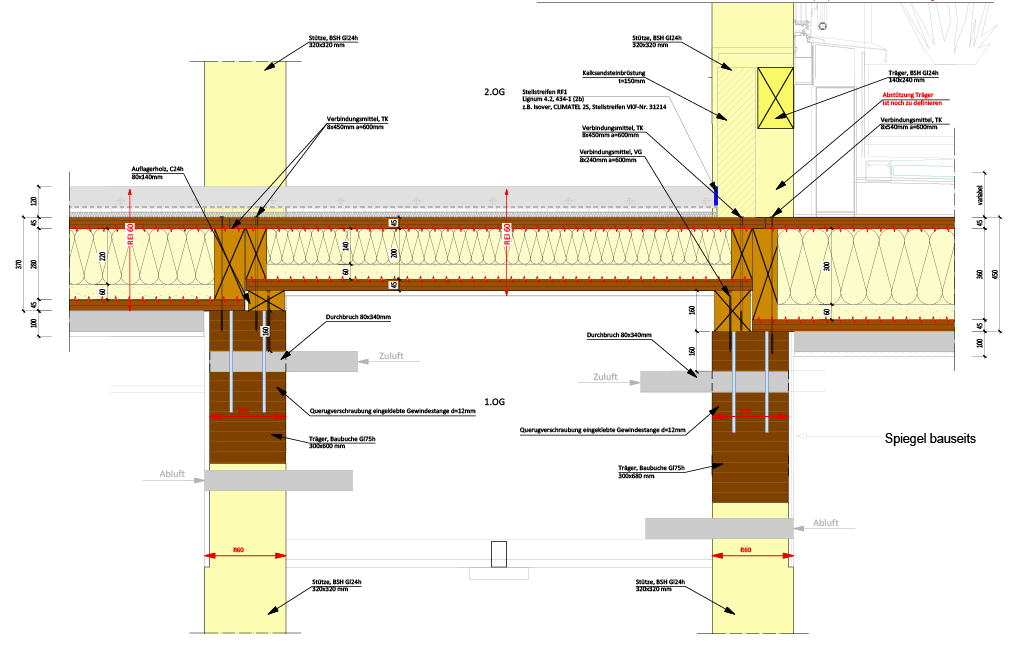
Below ground level, we find a solid construction foundation. Due to the slope of the site dropping 2.50 metres from the south-west to the north-east corner, the ground floor is partially underground on the east side, whilst on the west side it is at ground level. Therefore, the utility and storage rooms are located in the east section of the building. There are also two basement levels providing space for a total of 180 cars. In addition to the foundations, the two service cores housing the stairwells, lifts and wet rooms are also constructed in reinforced concrete and act as stiffening structures.
BauBuche as a material-efficient addition in specific building areas
Even though it is rarely visible in its natural state, BauBuche is a key component of the load-bearing structure. All main and façade beams are constructed using BauBuche of strength class GL 75h. BauBuche performs exceptionally well under both bending and transverse compression, meaning that, for example, the height of the girders is much smaller than would be the case with an alternative construction using spruce glulam. Accordingly, the girders with a width of 30 cm or 32 cm respectively have various heights, depending on their position within the building. For instance, along axis F – between the corridor and the meeting rooms at ground floor level on the south side – they measure 60 cm in height, whereas the girders located along the outer axes on the top floor are only 36 cm or 32 cm high. Particularly high loads occur in the area of the atrium terrasses on the second floor. Therefore, the hollow box ceiling here measures just under 45 cm in height, while the BauBuche beams are 68 cm high, which is still very slim for such loads.
The developer paid particular attention to the sustainability of their office building, for example by carefully choosing where glulam and BauBuche are to be used, thus allowing these materials to play a defining role in the architectural design, even if the BauBuche elements are not visible in all areas. The decisive factor was thereby the load-bearing capacity of BauBuche, which is comparable to that of steel and therefore enabled the designers to reduce the volume of steel used in the construction. By choosing BauBuche, a raw material that is both renewable and highly durable could be used in a most material-efficient manner.
Conclusion and outlook
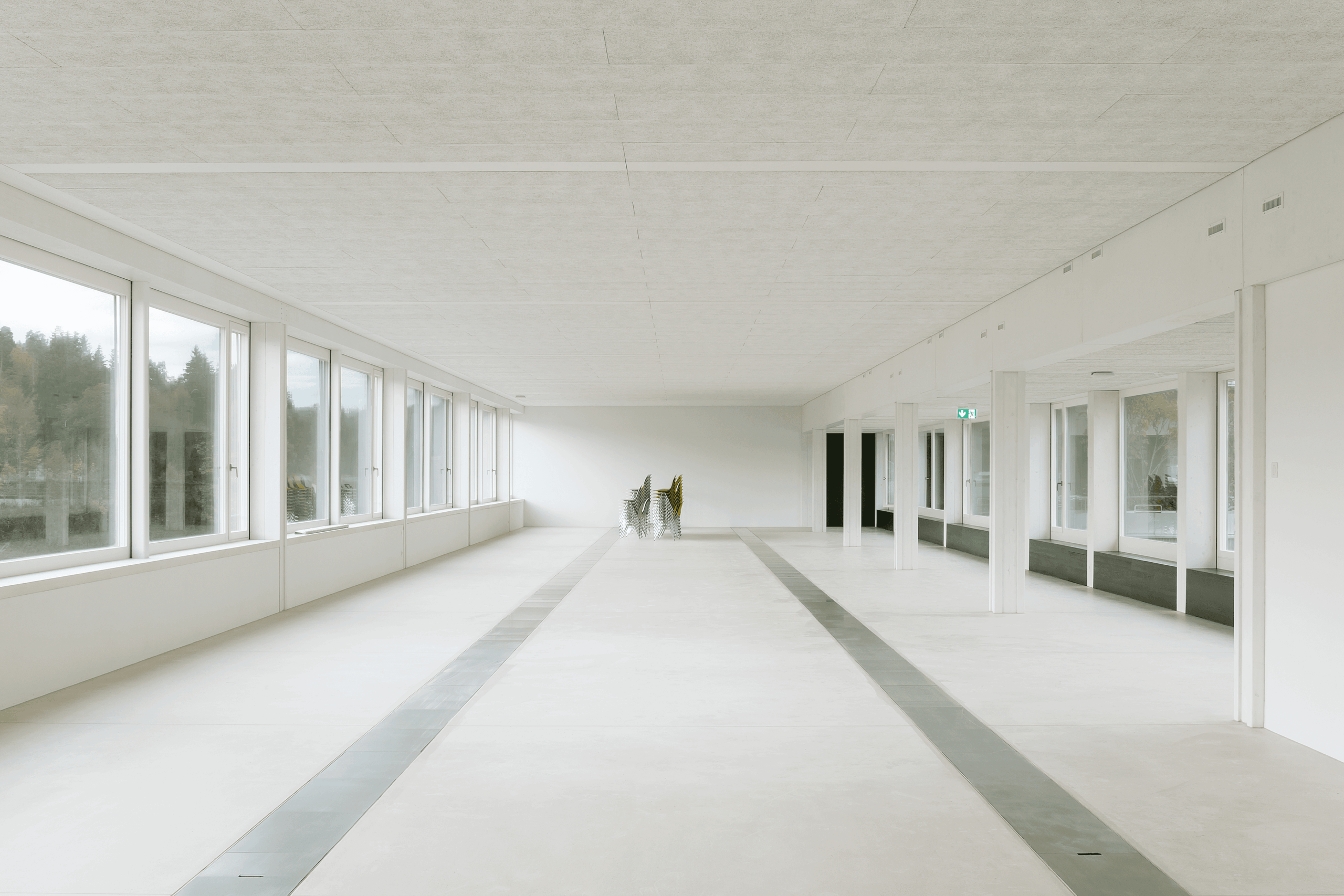
The flexible floor plan, made possible by the timber frame construction, allows for easy adaptation to changing ways of working or division into smaller rooms. This has of course a positive impact on the building’s longevity.
BauBuche of strength class GL 75h was used for the main beams. These carry the ceiling elements. BauBuche was chosen for is excellent material properties as regards bending and shear strength. This material allows the beams to be much slimmer than would have been possible with a different construction method. Thanks to BauBuche’s high transverse compressive strength, it was possible to reduce or even omit transverse compressive reinforcements at the floor-to-floor transitions. In principle, it would also have been feasible to build the office block using spruce glulam. However, for architectural reasons, the proprietor was looking for slender cross-sections throughout the construction. The building components are mainly secured with mechanical fasteners. When the building reaches the end of its service life, it can therefore be easily dismantled with proper separation by material type for reuse or safe disposal. The building service equipment is fully accessible through the visibly secured ceiling elements. The primary and secondary structures as well as the ceiling elements made from spruce and beech sequester around 1,400 tonnes of CO2.
text by: Susanne Jacob-Freitag, Karlsruhe
Please note: The article is protected by copyright. For use or publication, please contact Pollmeier or the author.

You are currently viewing a placeholder content from Vimeo. To access the actual content, click the button below. Please note that doing so will share data with third-party providers.
More InformationYou are currently viewing a placeholder content from YouTube. To access the actual content, click the button below. Please note that doing so will share data with third-party providers.
More InformationYou need to load content from reCAPTCHA to submit the form. Please note that doing so will share data with third-party providers.
More InformationYou are currently viewing a placeholder content from Facebook. To access the actual content, click the button below. Please note that doing so will share data with third-party providers.
More InformationYou are currently viewing a placeholder content from Instagram. To access the actual content, click the button below. Please note that doing so will share data with third-party providers.
More InformationYou are currently viewing a placeholder content from Google Maps. To access the actual content, click the button below. Please note that doing so will share data with third-party providers.
More InformationYou are currently viewing a placeholder content from Mapbox. To access the actual content, click the button below. Please note that doing so will share data with third-party providers.
More InformationYou are currently viewing a placeholder content from OpenStreetMap. To access the actual content, click the button below. Please note that doing so will share data with third-party providers.
More InformationYou are currently viewing a placeholder content from Google Maps. To access the actual content, click the button below. Please note that doing so will share data with third-party providers.
More InformationYou are currently viewing a placeholder content from X. To access the actual content, click the button below. Please note that doing so will share data with third-party providers.
More Information